
Tony Campbell added a new photo to the album: Branches of Christianity.
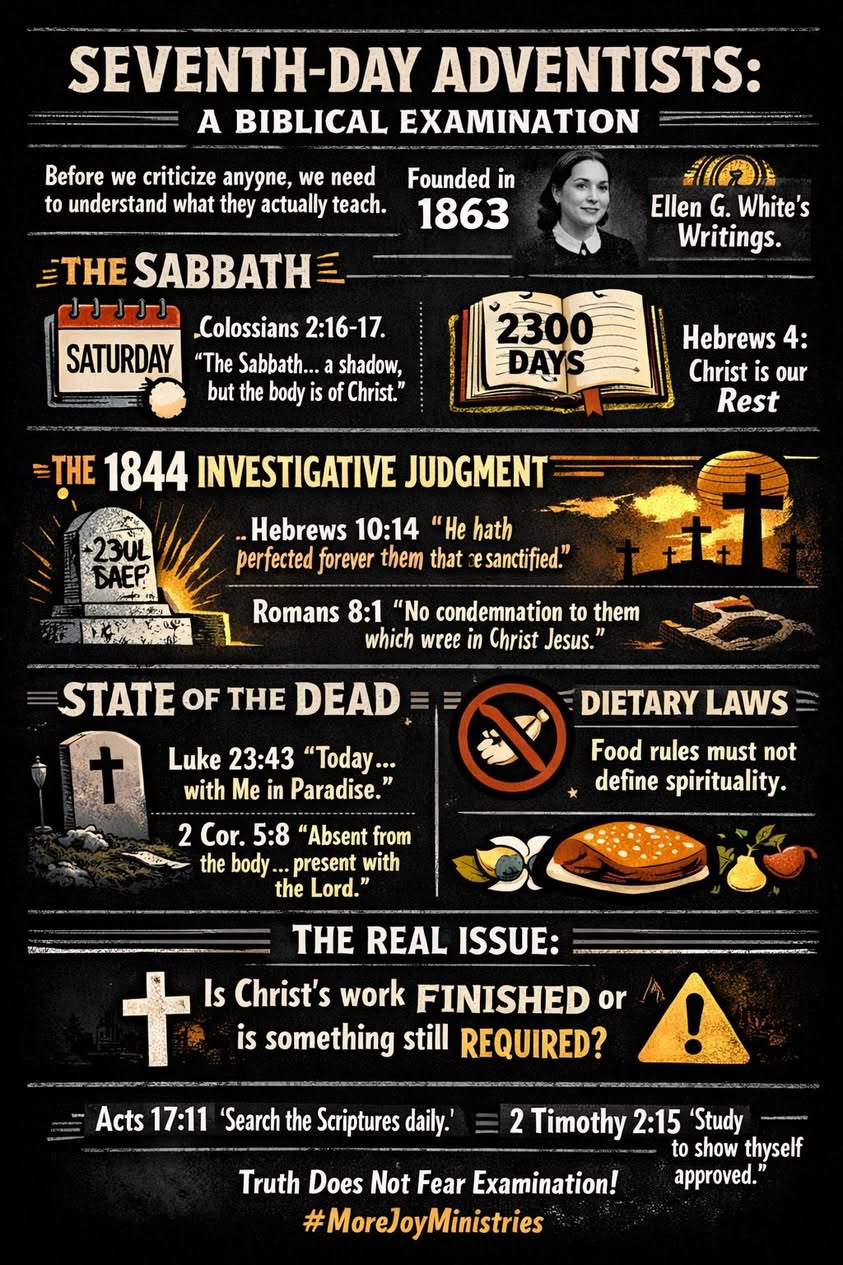
Branches of ChristianitySEVENTH-DAY ADVENTISTS: A BIBLICAL EXAMINATION Before we criticize anyone, we need to understand what they actually teach. The Seventh-day Adventist Church grew out of the 1
Branches of ChristianitySEVENTH-DAY ADVENTISTS: A BIBLICAL EXAMINATION
Before we criticize anyone, we need to understand what they actually teach.
The Seventh-day Adventist Church grew out of the 1800s Millerite movement and was formally organized in 1863. A key influence in its formation was Ellen G. White, whose writings still shape Adventist theology today.
Let’s examine the core doctrines carefully and biblically.
First, the Sabbath.
Adventists teach that Christians are still obligated to observe the seventh-day Sabbath, Saturday, as binding moral law. They argue the Sabbath was instituted at creation in Genesis 2 and codified in the Ten Commandments in Exodus 20. They believe it was never abolished.
The question is not whether the Sabbath is good. It is whether it is covenantally binding under the New Covenant.
Colossians 2:16–17 says, “Let no man therefore judge you… in respect of… the sabbath days: which are a shadow of things to come; but the body is of Christ.”
Romans 14:5 says, “One man esteemeth one day above another: another esteemeth every day alike.”
Hebrews 4 teaches that Christ Himself is our rest.
If someone chooses to worship on Saturday, that is liberty. If Sabbath keeping becomes a test of faithfulness or salvation, that is law creeping back in.
Second, the 1844 Investigative Judgment.
This is unique to Adventism.
They teach that in 1844, Jesus entered the Most Holy Place in heaven to begin examining the records of believers before His return. This is tied to Daniel 8:14 and the “2300 days.”
The New Testament repeatedly declares Christ’s work finished.
Hebrews 10:14 says, “For by one offering He hath perfected for ever them that are sanctified.”
Romans 8:1 says, “There is therefore now no condemnation to them which are in Christ Jesus.”
If justification is complete at the cross, then our standing before God is not awaiting a heavenly audit.
The gospel is not probation. It is finished redemption.
Third, the state of the dead.
Adventists teach “soul sleep,” meaning the dead are unconscious until resurrection.
Yet Jesus told the thief in Luke 23:43, “Today shalt thou be with me in paradise.”
Paul said in 2 Corinthians 5:8 that to be absent from the body is to be present with the Lord.
There is tension here that must be wrestled with honestly.
Fourth, dietary laws and health emphasis.
Many Adventists avoid pork and follow Old Testament food restrictions. Health discipline is not wrong. But Colossians 2 warns against allowing food regulations to become spiritual measurement.
Now here is the real issue.
Officially, Adventists affirm salvation by grace through faith. They affirm the Trinity, the deity of Christ, and the resurrection. That places them within Christian orthodoxy in many areas.
But whenever Sabbath keeping, investigative judgment, or law observance becomes part of what secures your standing before God, grace is no longer standing alone.
The line is not Saturday versus Sunday.
The line is this:
Is Christ’s atonement fully sufficient and finished, or is something still required to secure final acceptance?
That is where discernment matters.
Study everything. Test everything. Hold fast to what is good.
Acts 17:11 2 Timothy 2:15
Truth does not fear examination.
- @[61583539981347:2048:More Joy Ministries]
#MoreJoyMinistriesSEVENTH-DAY ADVENTISTS: A BIBLICAL EXAMINATION Before we criticize anyone, we need to understand what they actually teach. The Seventh-day Adventist Church grew out of the 1800s Millerite movement and was formally organized in 1863. A key influence in its formation was Ellen G. White, whose writings still shape Adventist theology today. Let’s examine the core doctrines carefully and biblically. First, the Sabbath. Adventists teach that Christians are still obligated to observe the seventh-day Sabbath, Saturday, as binding moral law. They argue the Sabbath was instituted at creation in Genesis 2 and codified in the Ten Commandments in Exodus 20. They believe it was never abolished. The question is not whether the Sabbath is good. It is whether it is covenantally binding under the New Covenant. Colossians 2:16–17 says, “Let no man therefore judge you… in respect of… the sabbath days: which are a shadow of things to come; but the body is of Christ.” Romans 14:5 says, “One man esteemeth one day above another: another esteemeth every day alike.” Hebrews 4 teaches that Christ Himself is our rest. If someone chooses to worship on Saturday, that is liberty. If Sabbath keeping becomes a test of faithfulness or salvation, that is law creeping back in. Second, the 1844 Investigative Judgment. This is unique to Adventism. They teach that in 1844, Jesus entered the Most Holy Place in heaven to begin examining the records of believers before His return. This is tied to Daniel 8:14 and the “2300 days.” The New Testament repeatedly declares Christ’s work finished. Hebrews 10:14 says, “For by one offering He hath perfected for e